Portfolio
Aura — Giving Agentic Development a UX Conscience
The team’s working model changed faster than its quality process. Product managers could make their ideas interactive themselves; engineers could turn those prototypes into features through coding agents. UX reviews still had value, but their usual place in the sequence was disappearing. I took that as a workflow problem: how could product judgment travel with the work?
I designed Aura around two practical uses: helping engineers review what they had built and helping product managers articulate what should be built. My contribution covered the agent workflow, its knowledge structure and the rules governing recommendations, escalation and approval. The aim was to make UX expertise available inside the team’s new way of working, including when no designer was involved in an individual change.
Process
Phase 01
Start with the environment
Useful recommendations depend on the environment they will land in. Aura first examines the stack, routing, templates, styling conventions and design system. This gives its review a technical frame of reference, without treating source inspection as proof of what people will experience in the browser.
Phase 02
Define who gets to decide
I specified the working agreement before expanding the feature set: surface uncertainty, announce changes and involve a person in critical decisions. Recommendations had to explain their reasoning and the available choices. The human interaction was part of the system architecture from the outset.
Phase 03
The first user changes the brief
The first developer wanted a whole-app review, rather than the single-feature check I had designed for. I added surface discovery, risk assessment and an explicit agreement on depth. A useful report needed to state its coverage as clearly as its findings.
Phase 04
Make the report worth reading
Heuristic, accessibility and content reviews could flag the same issue repeatedly. I introduced consolidation and shared severity rules to reduce duplication. One rule escalated findings supported by several checks. I would now evaluate that rule more carefully: agreement may increase confidence, but confidence and user impact are different things.
Phase 05
Fix my own interface first
My first command structure exposed the architecture rather than the task. I replaced the vague entry point with recognisable jobs: review a feature, inspect a merge request, assess an app or develop something new. Aura also states its understanding before proceeding. The reviewer needed a little review of its own.
Phase 06
Move the conversation upstream
I extended Aura to interview the person proposing a feature, produce a UX specification and review that specification before handoff. This brought the reasoning earlier into the process. Passing its own review is useful feedback, but cannot establish that a specification is complete or correct.
Phase 07
Give the rules a maintenance path
A manually triggered maintenance routine compares cited standards with their sources and proposes updates for approval. It gives the team a way to maintain the knowledge after the original author has stepped away, with changes that can be inspected and discussed.
Methods
Separate knowledge from orchestration
Domain rules and workflow instructions occupy separate layers. This makes it easier to revise a discipline or a process step without entangling every other part of the system.
Design the human decision
Approval is a designed interaction. Ethical findings require individual decisions even when a user has requested a bulk action.
Use a shared review vocabulary
A shared three-level rubric keeps disciplines from inventing incompatible severity scales. Individual judgments still need to remain open to inspection and challenge.
Make adaptation explicit
Company-specific guidance sits in a replaceable layer. Portability is a design intention, with suitability to be established in each new environment.
Visuals
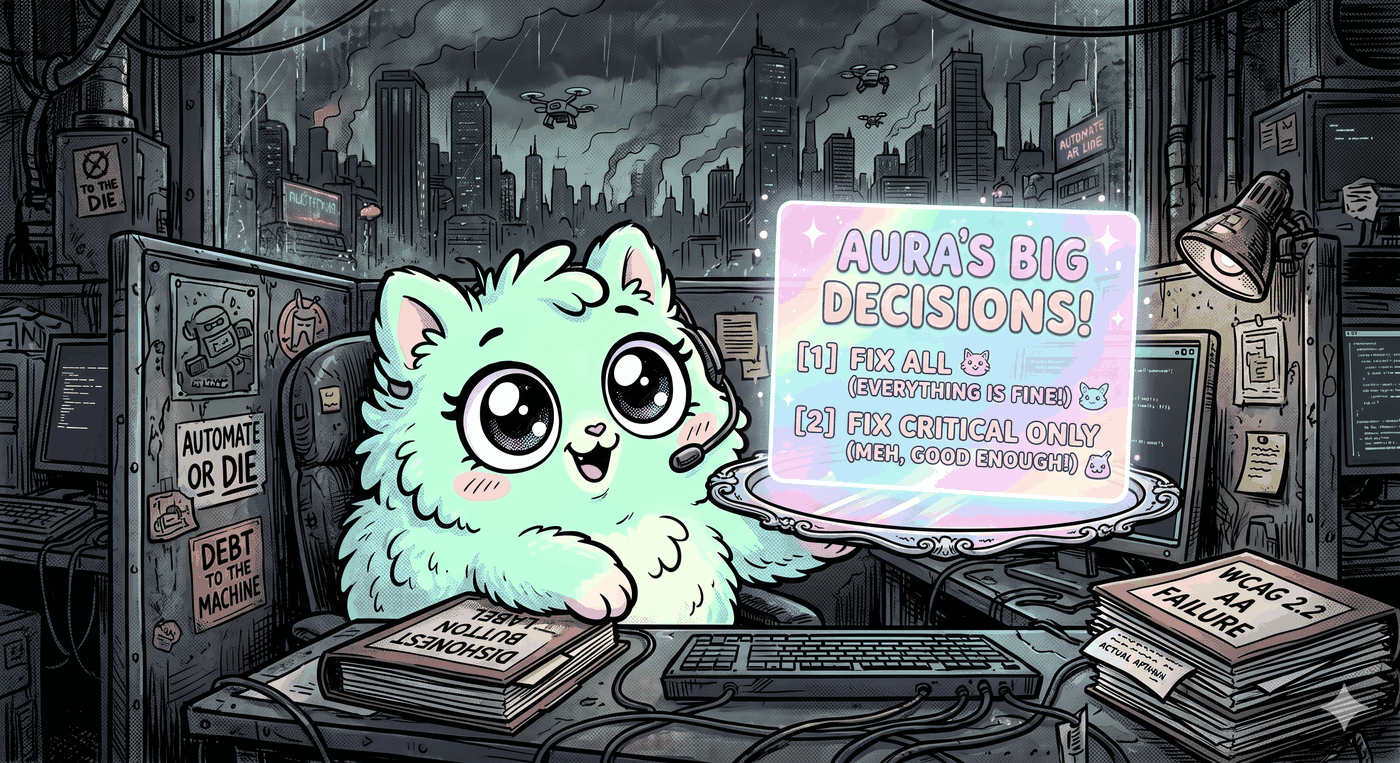
The decision menu makes choices and next steps explicit; bulk actions are not preselected.
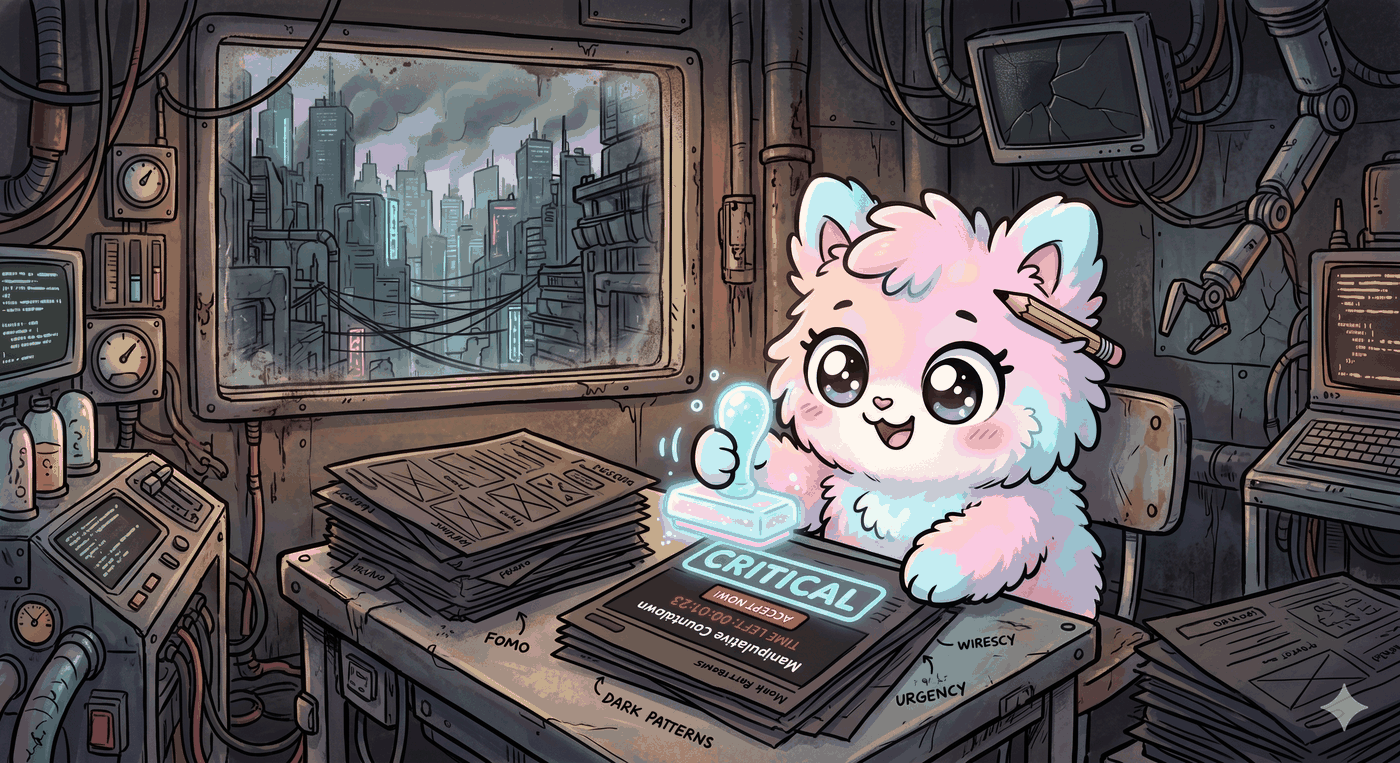
Example findings on manipulative patterns and contrast, presented for human review.
Key Takeaways
Treat the workflow as a product
The change in production speed made the surrounding workflow a product problem in its own right.
Accountability needs an interface
Decision rights, escalation and uncertainty all shape whether people can work responsibly with an agent.
Expect adoption to change the design
Real use changed both the scope and the entry points. The agent’s own usability needed development alongside its expertise.
Measure the judgments, too
Readable instructions and initial adoption provide a starting point. Trust also requires evidence about false alarms, missed problems and how people act on the advice.
The team used Aura for reviews. Its instructions and domain knowledge live in versioned Markdown, while the underlying AI tools perform the work. That makes the rules inspectable, although inspectable rules do not by themselves establish reliable judgments. Further work concerned recurring findings and rejected recommendations. The case demonstrates a working approach to process integration; it does not yet provide quantified evidence of detection accuracy or time saved.